
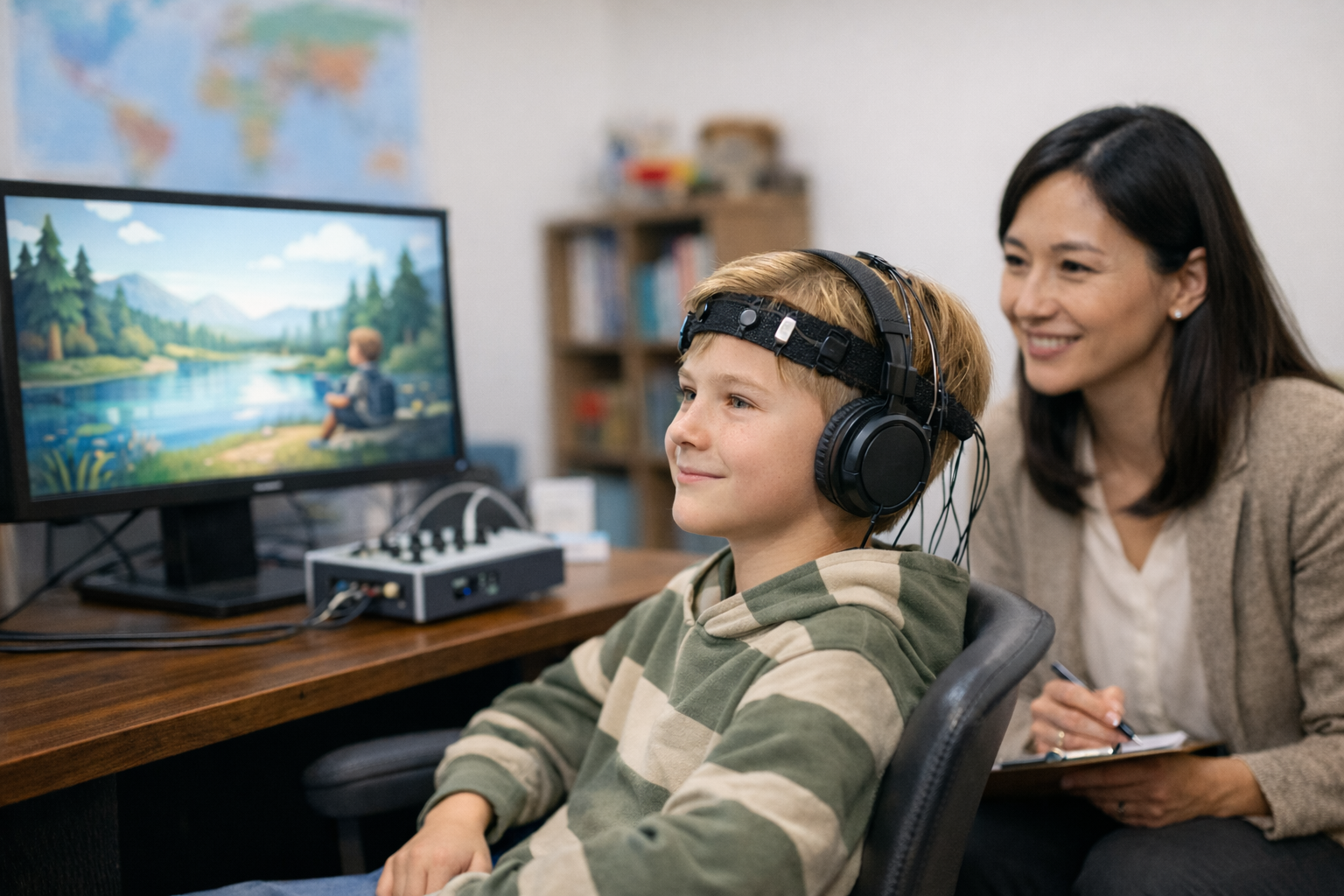
Raising children in a foreign country can be both enriching and quietly stressful—especially for expat families and international students living in South Korea. Many children adapt well on the surface while struggling internally with attention, emotional regulation, anxiety, or academic pressure. When talk therapy alone isn’t enough—and medication doesn’t feel like the right first step—neurofeedback can offer a gentle, science-based option.
This article explains how neurofeedback supports expat children, teens, and international students in Korea, and why it can be particularly helpful for kids navigating multiple cultures, languages, and education systems.
Why Expat Children in Korea Experience Unique Stress
International and expat children in Korea often grow up switching languages daily, adapting to different classroom expectations, navigating their identity across cultures, and feeling pressure to “represent” their family well—demands that can quietly shape their stress levels, confidence, and sense of belonging.
Even confident, high-achieving students can carry chronic nervous system stress, especially when emotional expression feels limited or misunderstood.
Common Challenges Seen in International Students
Parents and teachers often notice:
Difficulty sustaining attention in class
Emotional outbursts or shutdowns at home
Anxiety around school performance or transitions
Trouble sleeping despite exhaustion
Sensory sensitivity or irritability
“Zoning out” or mental fatigue
These patterns are common among third-culture kids (TCKs) and international students—not because something is “wrong,” but because their brains are working overtime to adapt.
What Is Neurofeedback?
Neurofeedback is a non-invasive brain training method that helps the brain learn calmer, more efficient patterns of activity.
For children, it often looks like:
Wearing small sensors on the scalp (no needles, no pain)
Watching a movie or game that responds to brain activity
The brain getting real-time feedback and self-adjusting
Children don’t have to “try hard” or talk about feelings. Their nervous system does the learning naturally.
Think of it as exercise for the brain’s regulation system.
Why Neurofeedback Works Well for Expat & International Kids
Many expat children are already verbally overloaded—from school, translation, and social navigation. Neurofeedback does not rely heavily on language, reduces the pressure to explain emotions, and supports self-regulation at a physiological level, making it especially helpful for individuals who struggle to verbalize their internal experiences.
This makes it especially helpful for:
Children who “can’t explain” how they feel
Kids who shut down during traditional therapy
International students fatigued by constant adaptation
Conditions Neurofeedback Commonly Supports in Expat Youth
Academic pressure and perfectionism
Attention and concentration difficulties (including ADHD)
Anxiety and school-related stress
Adjustment stress after relocation
Emotional reactivity or meltdowns
Nervous system exhaustion
Trauma or cumulative relocation stress
Sleep regulation issues
Neurofeedback can be used alone or alongside therapy, depending on the child’s needs.
What a Typical Neurofeedback Program Looks Like
Initial Assessment & Create Individualized Neurofeedback protocol
30 minute sessions, 1-2 times/wk
Progress monitored over time
Parents often report changes such as:
Improved focus and follow-through
Fewer emotional explosions & Improved emotion regulation
Better sleep
Increased emotional flexibility
Neurofeedback for International Families at MindFlow
At MindFlow Psychological Services, neurofeedback is integrated into a comprehensive, child-centered approach. We specialize in working with:
Expat and international families
Children attending international and foreign schools
Multicultural and third-culture kids
English-speaking families living in Korea
Our work emphasizes developmental sensitivity, cultural context, and parent collaboration—not quick fixes.
A Gentle Invitation for Parents
If your child is doing “okay” but seems constantly dysregulated, exhausted, or overwhelmed, it may not be a discipline or motivation issue—it may be a nervous system issue.
Neurofeedback offers a safe, non-medication-based option to support regulation, focus, and emotional resilience for expat children and international students in Korea.
MindFlow Psychological Services provides neurofeedback and therapy in English for international families in South Korea. We’re here to support your child—not just to cope, but to truly settle and thrive.
👉 Contact MindFlow to explore whether neurofeedback may be a good fit for your child or teen.
